
Farming Off‑Grid: Building a Solar‑Powered Irrigation System
By Teagan Moran, OSU Extension Service and Scott Duckett, The Farm Up Lost Creek
Published: May, 2026
When Scott Duckett returned to his family’s 22‑acre property near Lost Creek in 2020, he wasn’t just coming home, he was stepping into a long‑imagined dream of building a farm from the ground up. The land had been in his family for more than 70 years, used mostly for pasture and hay. Scott and his wife Katherine arrived with a clear vision: plant perennial food crops that could feed people and restore the land.
The property sits in a small foothill valley 25 minutes outside Eugene, at the gateway to the Middle Fork River and the Cascades. It produced hay in the 1970s and early 1980s and supported cattle and horses, but intensive agriculture hadn’t occurred there for decades. “To my knowledge, the soils have never been sprayed,” Scott said. Still, the farm faced a major hurdle: it had no agricultural infrastructure. No irrigation system. No power. No water rights. And no straightforward path to securing any of those things.
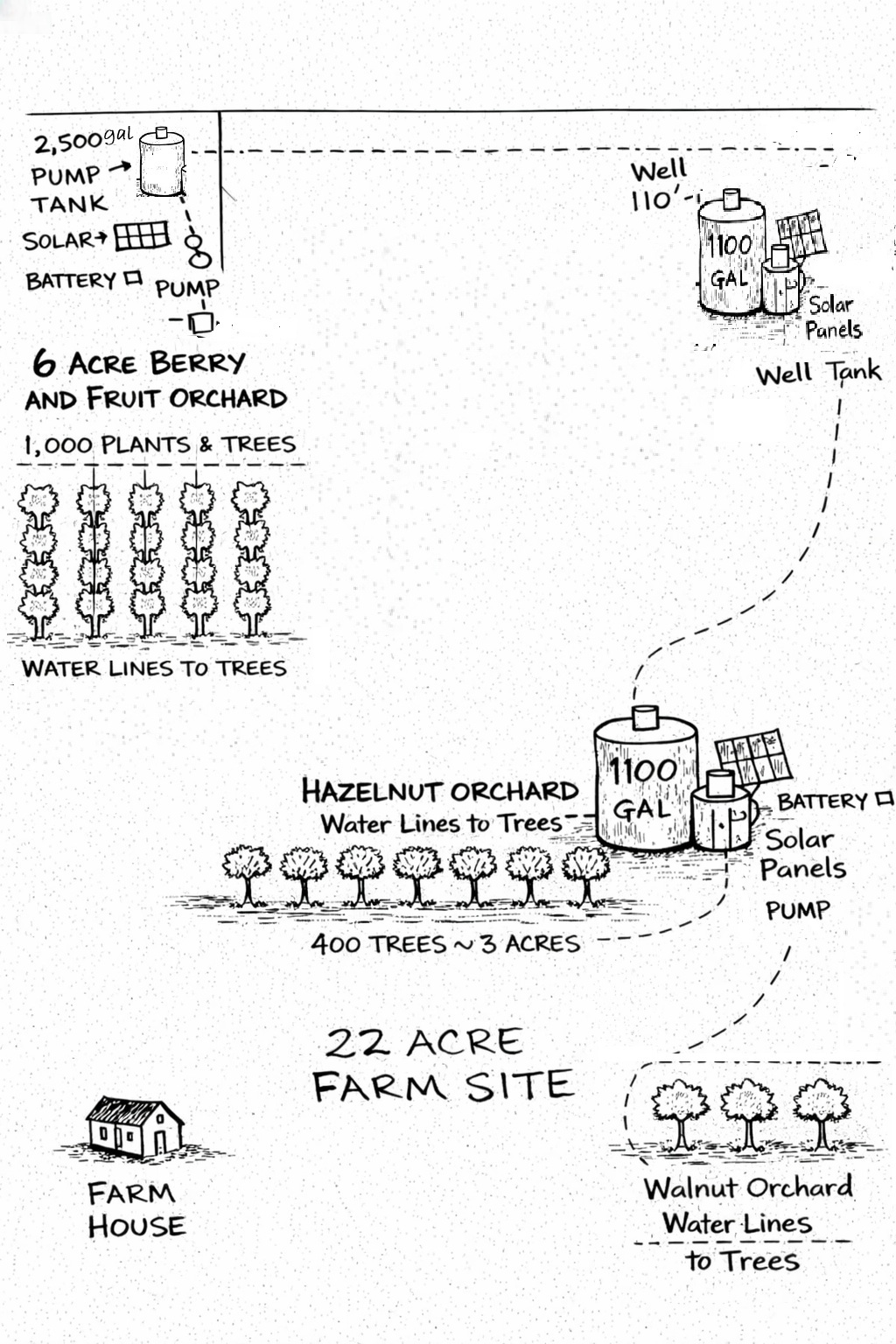
“It was a rectangular piece of land with no infrastructure other than fencing,” Scott explained. “Running electricity to the property was going to be incredibly expensive. Water storage wasn’t feasible. And I didn’t live on the farm full‑time, so I needed a system that could run without me being there every day.” That challenge set him on a multi‑year journey to design an off‑grid, solar‑powered watering system capable of supporting hazelnuts, berries, grapes, walnuts, and a growing fruit orchard — all without traditional utilities.
Starting From Scratch: Soil, Fencing, and the First Crops
Scott began the way many new farmers do: by learning everything he could. He enrolled in OSU Extension’s classes, including agritourism and soils courses. “The soil class really informed my decision‑making around the farm,” he said. “It helped me understand where to plant different crops.” Beyond classes, he relied heavily on Extension’s online resources to plan his crops and planting methods, and he reached out to Extension staff who connected him with on‑campus experts when he had specific crop questions. “The Extension program and staff were instrumental in providing me technical and moral support throughout my first several years,” he said.
He started small with a quarter‑acre strawberry patch watered from the domestic well at the nearby house. But he quickly realized that relying on residential water for commercial crops wasn’t sustainable or legally appropriate long‑term. “My water plan kept going back and forth between planning for not having water and planning if I had water,” he said. Meanwhile, he continued planting hazelnuts, berries, grapes, and a diverse orchard — all crops that could survive without irrigation but would establish better with it. By 2024, he had added a small walnut orchard and plots for grains and beans.
The Water Rights Roller Coaster
Knowing irrigation would eventually be necessary, Scott applied for a temporary water right to establish his perennial crops, and it was approved. He later submitted an application for a permanent right which was well received. During that period, statewide interpretation of groundwater data shifted, and his previously promising application was denied. It was a discouraging setback, but after an appeal process and further review, the state determined that his application met the updated criteria. His permanent water right is now moving through final paperwork which is a critical step in securing the farm’s long‑term future.